Introduction
In a classroom or play area setting, you can find children who are brave and adventurous, and others who prefer to observe first, then join the activities. We’re going to look at shy and social children side by side to educate caregivers and help them recognize children’s strengths, so they can better support them.
This diagram is based on our team’s interview with an experienced teacher who has worked with children ages three to seven. It highlights a variety of strategies that support the development of key academic, language, cognitive, and social skills for both shy and social children. We hope you find this information useful, and we welcome any questions you may have.
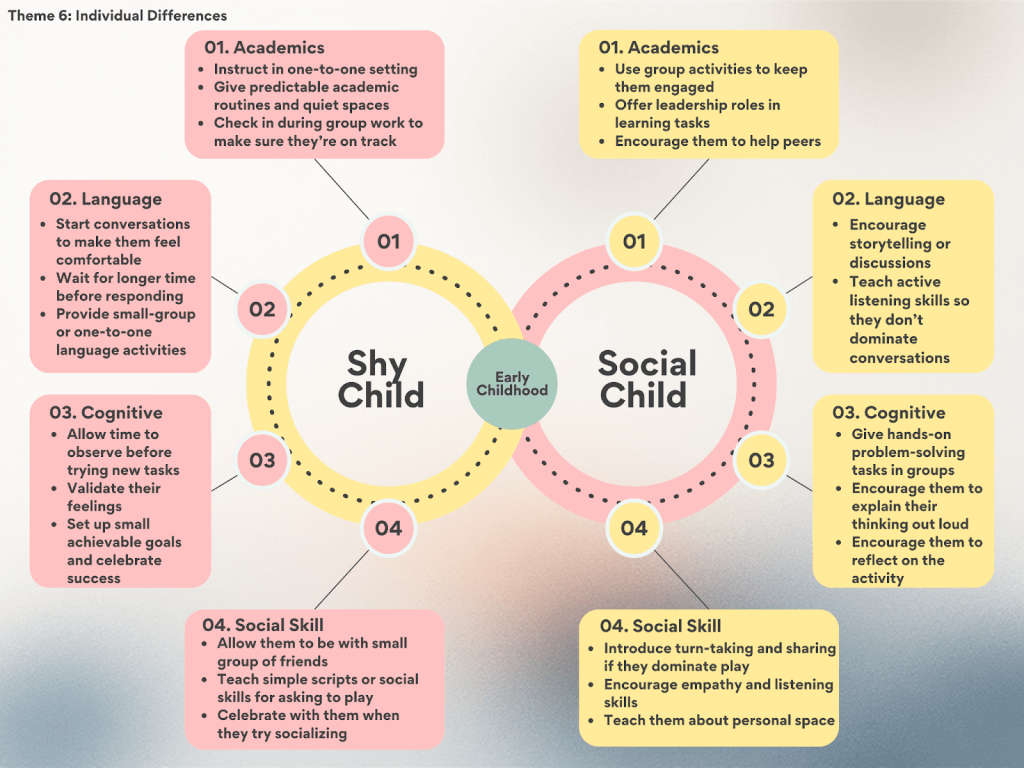
Here, we are excited to present a real-life example of how teachers use tailored strategies for children of different temperament and needs:
This real-life example takes place in a Form I lower school classroom.
Alex is a shy boy who prefers a quiet environment for studying, while Johnny enjoys socializing and often talks during class. Since they are neighbors and already knew each other, they chose to sit together since the first day of school. At first, things went great. When Alex had questions, he was too shy to ask the teacher, so he turned to Johnny, who patiently helped him. Both children were doing well academically and having positive moods for school.
However, after about a month, the teacher noticed that Alex’s grades had dropped and that he often seemed upset. At the same time, Johnny became increasingly active. He frequently interrupted his classmates or shouted, “I know everything! Just ask me!” whenever someone asked a question. This is because Johnny had not yet learned about taking turns, respecting boundaries, or having empathy. In a conversation with him, Johnny shared that he felt proud when he knew something Alex didn’t and wanted to feel that way with the whole class.
Solution:
To support both children, the teacher separated Alex and Johnny so each could better focus on their own work. She gently taught Johnny about the importance of taking turns by asking, “If people didn’t let you speak in class, how would you feel?” Johnny replied that he would feel sad and annoyed. She then explained that if he continued interrupting others, his classmates would feel the same way. Johnny understood and began to develop empathy. Although he occasionally interrupted in the following days, he stopped immediately when reminded.
Meanwhile, the teacher helped Alex build confidence by giving him opportunities to ask questions directly in a safe environment. Whenever Alex asked a question, she celebrated his effort by saying things like, “That’s a great question,” or “Good job, Alex.” She also checked in with both children regularly to make sure they were feeling well and making academic progress. Over time, both boys improved academically and became more confident and socially capable.
Reflection:
The case of Alex and Johnny highlights the importance of offering different strategies to support children with unique temperaments and needs. This aligns with developmental psychology theories on individual differences, which emphasize that children vary greatly in emotional, academic, social, and cognitive development style. Understanding these differences allows parents and caregivers to adapt the most suitable approach of support to different children.
 growinglittleminds.blog
Leave a comment