Introduction
In this infographic, we present three developmental psychology theorists, Piaget, Vygotsky, and Erikson. Although their theories vary, they all emphasize the importance of hands on support from caregivers to children.
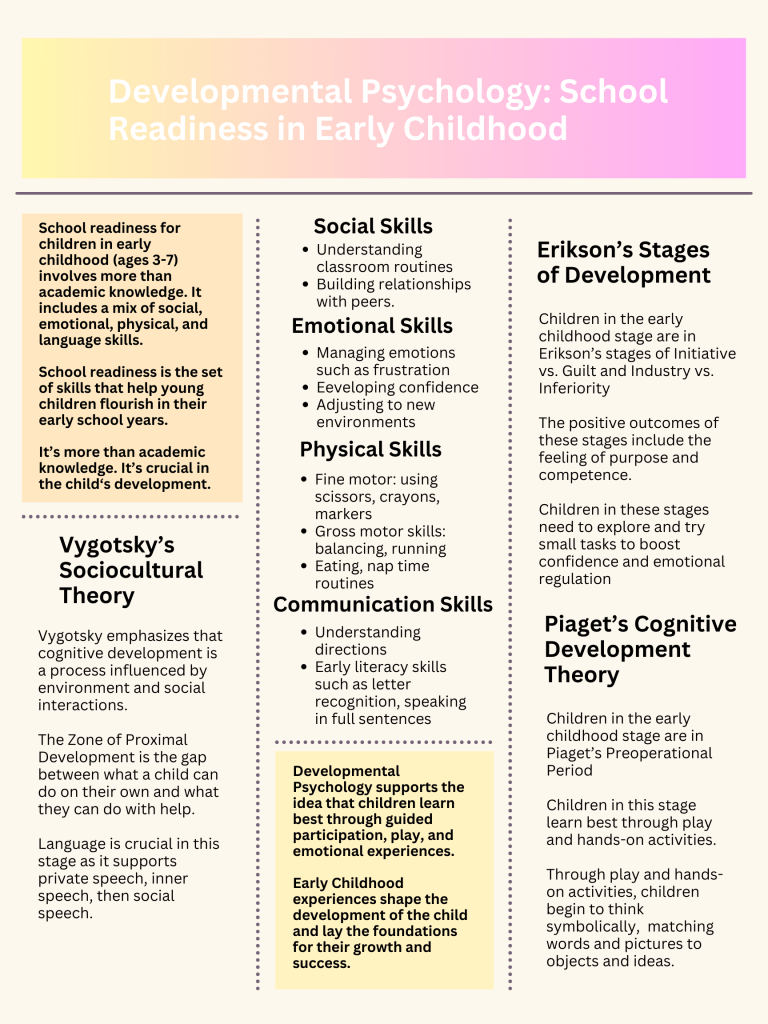
Some ways to connect the infographic above to real-life scenarios:
An example is a 5-year-old child learning to write their name. The teacher can provide guidance first, then gradually reduce support to reinforce learning. Some ways to teach this include tracing and using letter blocks to help them improve letter recognition and writing skills. This is an example of scaffolding, which is support within the Zone of Proximal Development, and is gradually lessened as the child learns to figure it out on their own.
In Erikson’s stage of Initiative vs. Guilt (ages 3-6), children are learning to be confident and independent in approaching tasks and activities. It’s crucial to encourage children to try tasks on their own and to help them manage their emotions when tackling more difficult ones. A mistake often made at this stage is over-criticizing a child when they make an error, which can lead to self-doubt and low confidence. A positive example of helping children at this stage would be to allow the child to choose their activity in class, such as building a tower with blocks. The teacher should encourage their efforts even if the tower falls and help them manage their emotions if they become frustrated.
In Piaget’s preoperational stage (Ages 2-7), children are quickly developing their language skills and imaginative play. Playing in this stage is crucial as it helps build their language skills and fosters empathy and social awareness. An example of this would be a child using prop money to “buy” items at a fake store. To support imaginative play, a caregiver would provide toys such as blocks, dolls, and fake food to create a space where children can play and explore different scenarios.
References
McLeod, S. (2025a, October 15). Erik Erikson’s Stages of Psychosocial Development. Simply Psychology. https://www.simplypsychology.org/erik-erikson.html
McLeod, S. (2025b, October 16). Vygotsky’s Theory of Cognitive Development. Simply Psychology. https://www.simplypsychology.org/vygotsky.html
McLeod, S. (2025c, October 22). Piaget’s Theory and Stages of Cognitive Development. Simply Psychology. https://www.simplypsychology.org/piaget.html
 growinglittleminds.blog
Leave a comment